A fellow's notebook, opened up.
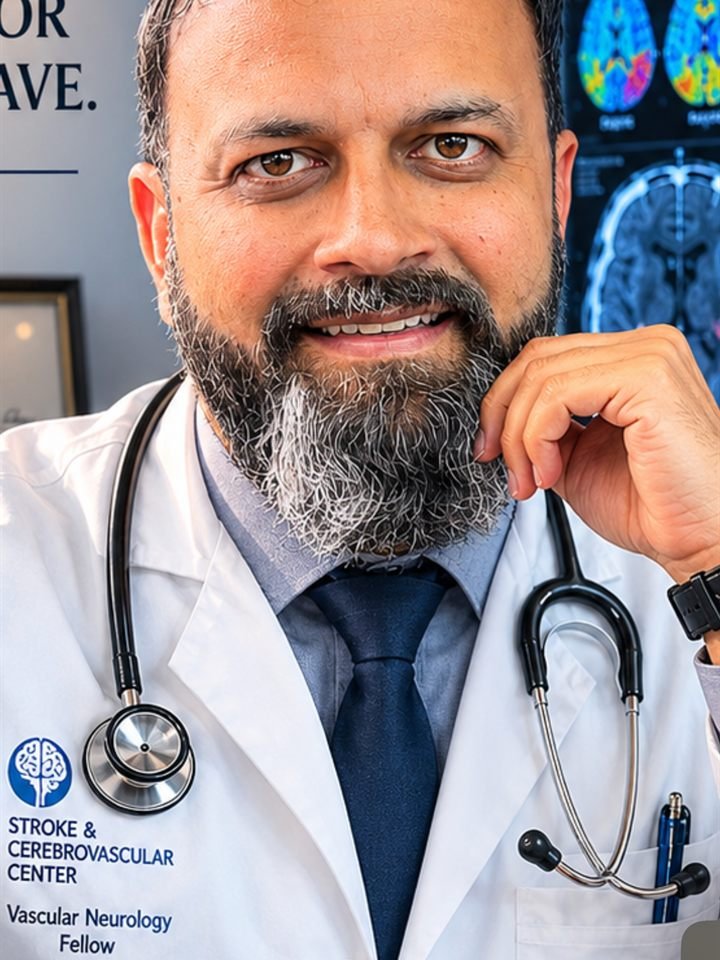
The Vascular Brain is a clinical education project by Zaka Ahmed, MD — a vascular neurology fellow at the University at Buffalo. A working notebook of trials, protocols, and bedside reasoning, kept honest by the consults that come in overnight.
Zaka Ahmed, MD.
Vascular Neurology Fellow · University at Buffalo · Board-eligible in Neurology
I am a vascular neurology fellow at the University at Buffalo, completing ACGME-accredited training across the full stroke continuum — prehospital triage, code stroke leadership, advanced neuroimaging, EVT coordination, and the long arc of secondary prevention. My clinical interests sit at the intersection of acute reperfusion, advanced neuroimaging, and the workflow problems that determine whether evidence actually reaches the patient on time.
Before fellowship, I trained in neurology at Howard University Hospital in Washington, DC — serving as Chief Resident in 2024–2025 and working with an underserved patient population where health equity in cerebrovascular care is not an abstraction. My research training has been split between the Hillis lab at Johns Hopkins, studying how language and motor functions recover differentially with reperfusion in large-vessel-occlusion stroke, and the neurocritical care group under Neeraj Badjatia at the University of Maryland, where I spent several years coordinating clinical trials in ICH, SAH, and ECMO outcomes.
This site is the long-form counterpart to that work — a place to write carefully about what the literature says and what it doesn't, in a voice that respects both the data and the clinicians who carry the weight of acting on it.
Acute ischemic stroke · thrombolysis with alteplase and tenecteplase · mechanical thrombectomy & post-EVT care · advanced perfusion imaging (CT/CTA/CTP, ASPECTS) · intracerebral & subarachnoid hemorrhage · neurocritical care · carotid duplex & transcranial Doppler · telestroke · stroke systems of care & quality improvement.
Education.
Board-eligible in Neurology. Active medical licenses in the District of Columbia and Virginia; New York licensure in progress. NIHSS certified. ACLS, BLS, PALS current.
Investigative work.
Studies on NIHSS sub-scores and the relative recovery of language versus motor function with reperfusion therapy in large-vessel-occlusion stroke. Senior author: Argye E. Hillis, MD.
Coordinated clinical trials in intracerebral hemorrhage, subarachnoid hemorrhage, and ECMO outcomes; IRB compliance, enrollment, and data integrity. PI: Neeraj Badjatia, MD.
MRI in Hyper-Acute Stroke Protocol — Howard University Hospital, 2024–2025. A workflow to incorporate rapid MRI into the acute stroke evaluation, with the goal of refining reperfusion selection without adding to door-to-needle time.
Selected publications & presentations.
- 01 Ahmed Z, Dehkordi O, Weir R, Oyawusi M, Mills RM. A case of Guillain-Barré syndrome with multiple causative factors in a young male. Cureus. 2023;15(11):e49745.
- 02 Ahmed Z, Yedavalli V, Gonzalez W, Hillis AE. Relative improvement in language vs motor functions with reperfusion therapies for acute stroke due to LVO. Neurology. 2023.
- 03 Younus F, Girio-Herrera L, Barrueto F, Ahmed Z, Zimand P. Tele-infectious disease consultation produces equivalent outcomes as in-person consultation. Open Forum Infectious Diseases. 2018;5(S1):S45.
- 04 Majoka H, Anand A, Khan I, Ahmed Z, et al. Impact of secondary brain injury on functional outcome in ECMO-treated adults. Neurocritical Care. 2016 (poster, Neurocritical Care Society).
- 05 Miller JC, Chang WT, … Ahmed Z, … Badjatia N. Acute MRI findings in non-traumatic intracerebral hemorrhage. Neurocritical Care. 2015 (poster).
Full list and additional poster presentations available on request.
Recognition.
A profile feature on my fellowship work in acute stroke care, advanced neuroimaging, and quality improvement at the Gates Vascular Institute. Read the spotlight →
"The pace, volume, and team culture sharpen decision-making and reinforce what matters most: delivering timely, equitable stroke care." Read on UB Neurology →
Affiliations & community.
English, Urdu, and Punjabi (native); Hindi (advanced). Patient and family conversations in any of these.
Why this site exists.
Stroke medicine is one of the most evidence-rich, time-critical fields in neurology — and one of the easiest places for a gap to open between what the literature says and what happens in the next hospital corridor. The Vascular Brain is an attempt to keep that gap narrow.
Each piece is written to be used: by the resident answering a stroke alert, by the fellow preparing for boards, by the nurse practitioner managing a long-term clinic, by a patient's family member trying to understand what just happened to someone they love. The voice is the same in all of them — careful, honest about uncertainty, and not afraid of detail.
The goal isn't to summarize trials. It is to translate them — into protocols, into decisions, into language a tired team can still act on at 3 a.m.
If you read something here that helps, or that you disagree with, write back. The notebook is better with company.