ASPECTS Score Calculator: 10 MCA Regions on Stroke CT
Free ASPECTS score calculator with an original visual map of all 10 MCA regions (C, L, IC, I, M1–M6) across the ganglionic and supraganglionic CT levels. Score 10 = no early ischemic change; each affected region subtracts one point.
Reviewed by Zaka Ahmed, MD Clinical reference · 8 min read
ASPECTS region tracker
Start at 10. Mark each MCA region with early ischemic change to deduct one point. Use trained image interpretation and inspect both hemispheres.
Educational use only. ASPECTS requires trained review of source imaging. The total does not independently determine thrombolysis or thrombectomy eligibility, especially in the large-core era.
Original bedside visual
Where the ten ASPECTS regions sit
Use the map as an orientation aid before scrolling the actual non-contrast CT. The drawing separates the ganglionic level (deep structures, insula, M1–M3) from the immediately superior supraganglionic level (M4–M6). It is deliberately schematic rather than a diagnostic segmentation overlay.
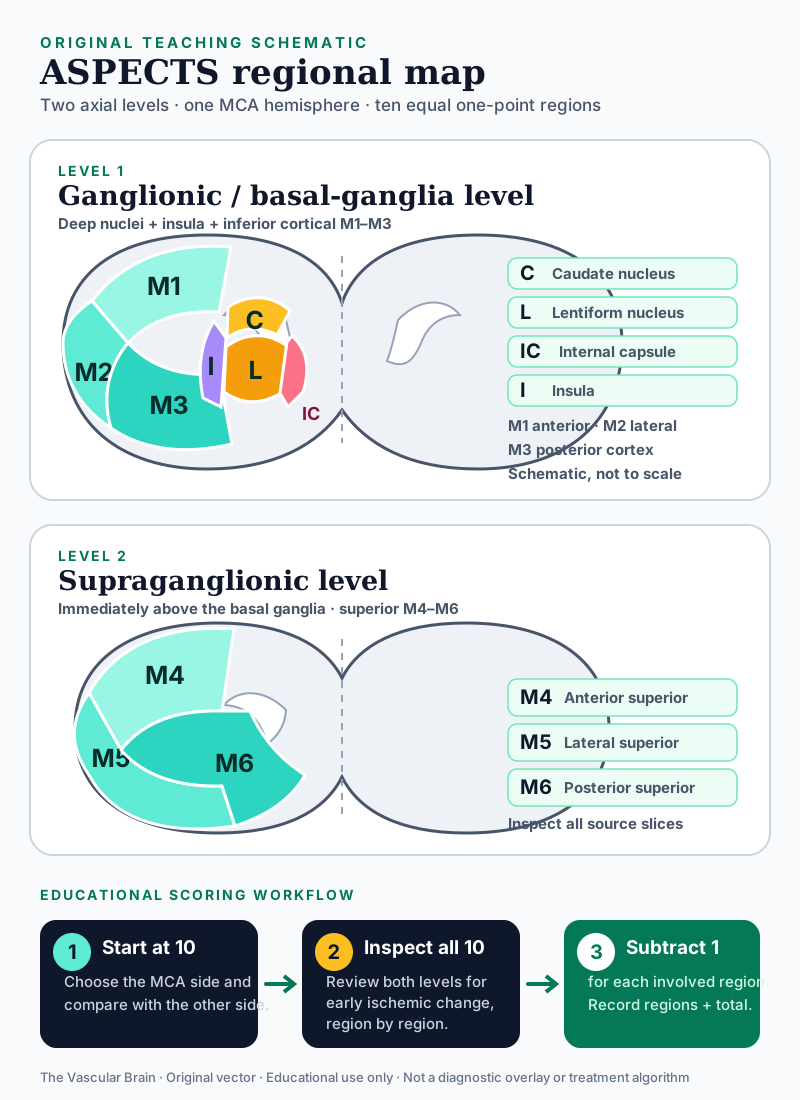
Ganglionic level · 7 regions
C caudate · L lentiform nucleus · IC internal capsule · I insula · M1 anterior inferior frontal cortex · M2 temporal cortex · M3 inferior parietal/posterior temporal cortex.
Supraganglionic level · 3 regions
M4 anterior superior frontal cortex · M5 precentral/superior frontal cortex · M6 superior parietal cortex. These lie immediately above M1, M2, and M3, respectively.
Educational use only. Do not score from this schematic. Review the full source CT with appropriate windowing and training. The total does not independently determine thrombolysis or thrombectomy eligibility; see the separate thrombectomy eligibility reference and your institutional pathway.
Clinical notes & interpretation Scoring guidance, pitfalls, FAQs, and references
ASPECTS is a 10-point topographic score that quantifies early ischemic change across the MCA territory on non-contrast CT, starting at 10 and subtracting one point for each of ten affected regions.
- → Ten regions across two axial levels — basal ganglia level (caudate, lentiform, internal capsule, insula, M1–M3) and supraganglionic level (M4–M6); a normal scan scores 10, total MCA infarction scores 0.
- → Score early ischemic change region by region on the source non-contrast CT, using the contralateral hemisphere for comparison and recording the regions as well as the total.
- → ASPECTS is an imaging description, not an automated treatment recommendation. Current thrombectomy selection combines the clinical syndrome, vessel imaging, time, core extent, and local protocol.
The Alberta Stroke Program Early CT Score (ASPECTS) was introduced to make early ischemic change on non-contrast CT more standardized than a gestalt estimate of how much MCA territory is involved. The original method divided the MCA territory into ten named regions and scored them on a pre-treatment CT.1 It remains widely used for describing early ischemic change, but reader training and full review of the source images still matter.2,8
At a glance · what the number changes
- 8–10. Limited early ischemic change across the ten MCA regions scored.
- 6–7. Intermediate burden. Older endovascular pathways emphasized ≥6; that threshold is no longer a decision rule on its own.
- ≤5. A larger established core. SELECT2, ANGEL-ASPECT, RESCUE-Japan LIMIT and TENSION showed benefit in selected patients in this range, so a low score is not an automatic exclusion.
- Scope. Non-contrast CT, MCA territory only — it says nothing about the posterior circulation, each region counts one point regardless of size, and DWI-ASPECTS is a separate scale.
- No verdict from the number alone. Occlusion site, time, deficit, prestroke function and the full imaging profile decide treatment; this score describes the CT.
How the score is built.
Start at 10 and subtract one point for each region showing early ischemic change, including focal swelling or parenchymal hypoattenuation. The score is applied to the MCA territory and organized around two standardized axial levels:2
- Basal ganglia level (at the level of the thalamus and basal ganglia) — seven regions: caudate, lentiform nucleus, internal capsule, insular ribbon, and the inferior MCA cortical zones M1, M2, M3.
- Supraganglionic level (just rostral, above the basal ganglia) — three regions: the superior MCA cortical zones M4, M5, M6.
M1–M3 are the anterior, lateral, and posterior cortical segments at the ganglionic level; M4–M6 are the corresponding segments immediately above it. A score of 10 has no scored early ischemic regions; 0 means all ten regions are involved. ASPECTS should be recorded with the affected side and the regions scored down, not only the total.
Bedside pearl
Each region is one point regardless of size — the tiny caudate counts the same as the large M5 cortical zone. ASPECTS counts how many regions are involved, not how much of any one region. Review an appropriate narrow stroke window alongside standard brain windows to improve the visibility of subtle gray–white loss.
What the score describes.
In the original derivation cohort of patients treated with intravenous alteplase within 3 hours, a lower baseline ASPECTS was associated with worse 3-month functional outcome and a higher risk of symptomatic intracerebral hemorrhage.1 At the cohort level, lower scores reflect early ischemic change across more MCA regions. ASPECTS is not a direct measurement of infarct volume, penumbra, or tissue viability, and it should not be used alone to predict treatment benefit or bleeding risk for an individual patient.
Why there is no treatment verdict here.
Older endovascular pathways often emphasized ASPECTS ≥6. Large-core randomized trials including SELECT2, ANGEL-ASPECT, RESCUE-Japan LIMIT, and TENSION subsequently demonstrated benefit from thrombectomy in selected patients with larger established infarcts, including trial populations with ASPECTS 3–5.3–6 The January 2026 AHA/ASA acute ischemic stroke guideline therefore reflects expanded endovascular treatment for some patients with larger ischemic cores.9
That evidence does not turn one ASPECTS number into a universal yes/no rule. Treatment selection depends on the occlusion, time, clinical deficit, prestroke function, the complete imaging profile, and the applicable protocol. This page calculates and explains the imaging score; it does not issue an automated reperfusion recommendation.
Where readers go wrong.
ASPECTS is only as good as the regions and source slices actually inspected. The caudate and insula can be subtle, especially when attention is drawn to more conspicuous cortical change. Deliberately inspect the insular ribbon, deep nuclei, internal capsule, and every cortical region. Reader agreement varies with experience; a schematic can orient the eye, but it cannot replace image-review training.8
Pitfall
Do not treat either a teaching map or an automated score as ground truth. Automated systems can perform comparably with expert reads in some datasets, but agreement is not perfect and source-image review remains necessary.10
Practical use at the bedside.
Use ASPECTS as one imaging description within a broader assessment that may include time from last-known-well, the NIHSS clinical deficit, vessel occlusion site on CTA, collateral status, and advanced imaging when applicable. Document the side, total, and the regions scored down so the next reader can reconcile the interpretation. This page is for clinician education and does not substitute for individualized clinical judgment or an institutional reperfusion protocol.
Frequently asked questions.
Does ASPECTS apply to posterior circulation strokes?
No. ASPECTS scores only the middle cerebral artery (anterior circulation) territory across two axial CT levels. Posterior circulation strokes use a separate adaptation, pc-ASPECTS, which scores different territories (such as thalami, cerebellum, midbrain, pons, and occipital lobes) and should not be conflated with the standard MCA score.
What counts as early ischemic change for scoring a region down?
The original method includes focal swelling or parenchymal hypoattenuation within a region. Each region is scored as involved or not involved; the amount of change within that region does not create extra deductions.
Which regions deserve a deliberate check?
The caudate and insula can be subtle beside more conspicuous cortical change. Inspect the insular ribbon and caudate head deliberately on every scan, then confirm the other deep structures and all six cortical regions.
Does an ASPECTS number determine thrombectomy eligibility?
No. Large-core trials expanded the evidence for thrombectomy in selected patients with more extensive early ischemic change, and the 2026 AHA/ASA guideline incorporates that evidence. Eligibility still depends on the full clinical and imaging context and the applicable treatment pathway.
Can I rely on automated ASPECTS software alone?
No. A systematic review found promising agreement between automated systems and expert readers, but performance varied across studies.10 Treat automation as decision support and confirm the result against the source non-contrast CT.
How does ASPECTS fit with perfusion imaging and CTA?
ASPECTS quantifies established change on non-contrast CT; it does not measure penumbra. In the extended window, perfusion mismatch (core versus salvageable tissue) and CTA findings such as occlusion site and collateral status add complementary information. ASPECTS is one axis in a multi-factor reperfusion decision, alongside time, NIHSS, vessel imaging, and patient-specific factors.
What does an ASPECTS score of 10 mean?
A score of 10 means none of the ten MCA-territory regions shows early ischemic change on the non-contrast CT. Each region with early change subtracts one point, so lower numbers mean more extensive involvement. A 10 does not exclude a stroke — early CT is often normal in the first hours — it means the CT has not yet declared the extent.
Is the "aspect score" the same as ASPECTS?
Yes. ASPECTS is the Alberta Stroke Program Early CT Score, and searches for an "aspect score calculator" or "aspects radiology score" refer to the same 10-point tool. It is read on non-contrast CT in the MCA territory and is not used for posterior circulation strokes.
References.
- Barber PA, Demchuk AM, Zhang J, Buchan AM. Validity and reliability of a quantitative computed tomography score in predicting outcome of hyperacute stroke before thrombolytic therapy. ASPECTS Study Group. Alberta Stroke Programme Early CT Score. Lancet. 2000;355(9216):1670–1674. PubMed
- Pexman JH, Barber PA, Hill MD, et al. Use of the Alberta Stroke Program Early CT Score (ASPECTS) for assessing CT scans in patients with acute stroke. AJNR Am J Neuroradiol. 2001;22(8):1534–1542. PubMed
- Sarraj A, Hassan AE, Abraham MG, et al. Trial of Endovascular Thrombectomy for Large Ischemic Strokes (SELECT2). N Engl J Med. 2023;388(14):1259–1271. PubMed
- Huo X, Ma G, Tong X, et al. Trial of Endovascular Therapy for Acute Ischemic Stroke with Large Infarct (ANGEL-ASPECT). N Engl J Med. 2023;388(14):1272–1283. PubMed
- Yoshimura S, et al. Endovascular therapy for acute stroke with a large ischemic region (RESCUE-Japan LIMIT). N Engl J Med. 2022;386:1303–1313. PubMed
- Bendszus M, et al. Endovascular thrombectomy for acute ischaemic stroke with established large infarct (TENSION). Lancet. 2023;402:1753–1763. PubMed
- Zou Z, Tu J, Hu W, Zhao X, Tang S. The prognostic value of ASPECTS in specific regions following mechanical thrombectomy in patients with acute ischemic stroke from large-vessel occlusion. Front Neurol. 2024;15:1340842. PubMed
- Farzin B, et al. Interobserver reliability of baseline noncontrast CT Alberta Stroke Program Early CT Score for intra-arterial stroke treatment selection. AJNR Am J Neuroradiol. 2012;33(6):1046–1049. PubMed
- Prabhakaran S, et al. 2026 Guideline for the Early Management of Patients With Acute Ischemic Stroke: A Guideline From the American Heart Association/American Stroke Association. Stroke. Published online January 26, 2026. doi:10.1161/STR.0000000000000513. AHA Professional Heart Daily
- Adamou A, et al. Artificial intelligence-driven ASPECTS for the detection of early stroke changes in non-contrast CT: a systematic review and meta-analysis. J Neurointerv Surg. 2023;15:e298–e304. PubMed
Related reading
From the articles.
- Trends in stroke care How large-core imaging changed who gets treated.
- The golden hour in stroke Why early ischemic change on CT matters so much.