Central Post-Stroke Pain: Recognizing and Treating the Burning the Stroke Left Behind
Months after a "good recovery," the arm starts to burn — and gets called arthritis, neuropathy, or anxiety. CPSP is the pain caused by the stroke itself, and it responds to different drugs than every other pain on the list.
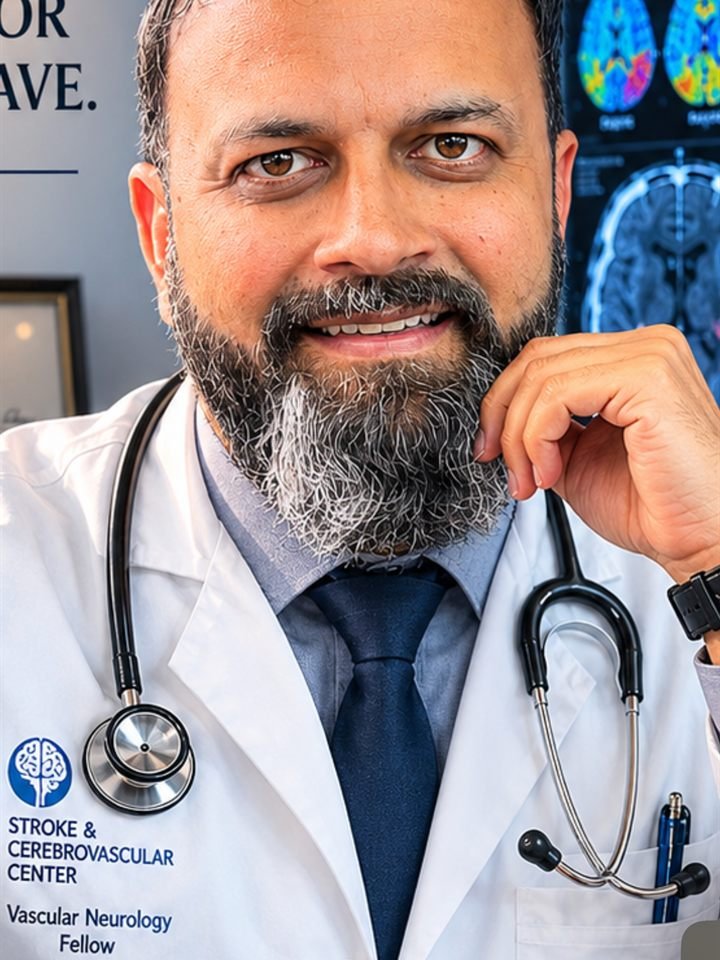
The pain arrives after the recovery — and it is generated by the lesion, not the limb.
- →Central post-stroke pain (CPSP) affects roughly 7–11% of stroke survivors in population studies and typically begins weeks to months after the stroke — often after the deficits have improved, which is exactly why it gets misdiagnosed.
- →It is neuropathic pain from the lesion itself — classically thalamic (Dejerine-Roussy), but any stroke along the spinothalamic pathway can do it, and lateral medullary (Wallenberg) strokes are notorious.
- →The diagnosis is clinical: pain in the territory that matches the lesion, plus spinothalamic sensory signs there — blunted pinprick and temperature, dysesthesia, or allodynia (pain from light touch or cool air).
- →First rule it apart from the commoner pains: hemiplegic shoulder pain, spasticity pain, and musculoskeletal pain — which respond to entirely different treatment.
- →Treat like neuropathic pain, dosed for an older stroke brain: amitriptyline and lamotrigine have small positive randomized trials; gabapentinoids are reasonable extras (the dedicated pregabalin CPSP trial missed its pain primary). Opioids largely fail. Promise meaningful relief, not zero pain.
Four months after her thalamic stroke, a patient comes back to clinic doing objectively well — walking unaided, back to cooking. But she cradles her right arm while she talks, and when I reach out to examine it she flinches before I touch her. The arm burns, she says. It burns all day, it burns worse in the cold, and her sleeve hurts. Her chart already carries three explanations from three visits: "arthritis," "possible neuropathy," "anxiety."
The exam takes two minutes and settles it. Pinprick is dull over the right arm and face compared with the left. A cold tuning fork, barely noticed on the left, is painful on the right. Light stroking of the forearm — a stimulus that should register as nothing — produces a wince. Pain in the territory of her stroke, with spinothalamic sensory signs in the same territory: this is central post-stroke pain, and it is generated not by her arm but by the lesion in her brain.1
What CPSP is, and who gets it
CPSP is central neuropathic pain arising from a cerebrovascular lesion of the somatosensory pathways — most characteristically the spinothalamic system that carries pain and temperature. The classic teaching case is the thalamic stroke (Dejerine and Roussy's eponymous syndrome), but the thalamus holds no monopoly: lateral medullary infarcts carry among the highest rates of CPSP of any stroke location, and lesions from brainstem to parietal operculum can produce it. Across stroke survivors overall, a commonly cited figure is that CPSP develops in roughly 8–10%; a Danish population-based examination found a minimum prevalence of 7.3% definite or probable CPSP.15
The timing is the trap. Onset is typically delayed — days to months, most within the first six months — arriving after the acute team has signed off and the narrative has become "recovering nicely." A new burning limb at month four rarely gets connected to the stroke at month zero unless someone makes the connection deliberately. The character is neuropathic: burning, aching, freezing, squeezing, lancinating; constant with paroxysms; aggravated by cold, touch, stress, and fatigue.
The two-minute exam that makes the diagnosis
There is no confirmatory test for CPSP; imaging already showed you the lesion. The diagnosis stands on three legs:
- Distribution: the pain occupies a body territory that makes neuroanatomical sense for the stroke — hemibody for thalamic lesions, crossed face-and-body patterns for lateral medullary (Wallenberg) lesions. Thalamic infarcts may sit in PCA territory; Wallenberg is PICA, not PCA.
- Sensory signs in that territory: blunted pinprick and temperature sensation are the signature (spinothalamic), often with preserved light touch and proprioception; plus the positive phenomena — dysesthesia, hyperalgesia, and allodynia, pain from a normally innocuous stimulus. A cold object and a pin answer most of the question at the bedside.
- Exclusion of the commoner pains — which is where most misdiagnosis actually happens.
| Pain after stroke | Tells | Treatment direction |
|---|---|---|
| Central post-stroke pain | Burning/freezing, delayed onset, spinothalamic sensory signs, allodynia, territory matches lesion | Neuropathic agents (this article) |
| Hemiplegic shoulder pain | Movement-related, localized to shoulder, subluxation or restricted range on exam | Positioning, therapy, targeted shoulder care |
| Spasticity-related pain | Tone, spasms, pain with stretch — see the spasticity guide | Treat the tone, hunt aggravators |
| Musculoskeletal / other | Joint-line findings, weight-bearing pattern; consider DVT in a swollen painful leg — score it with Wells DVT | Cause-specific |
"Arthritis" that burns, hates cold, and lives on the stroke side deserves a pin and a cold tuning fork before it deserves an NSAID.
Treatment: the evidence, and how to dose it for a stroke brain
CPSP is treated as neuropathic pain, and the honest preamble to every prescription is about expectations: the realistic goal is meaningful reduction — commonly framed as 30–50% — plus better sleep and function, not elimination. Setting that frame early is the difference between a treatment partnership and a march through abandoned prescriptions.
- Amitriptyline carries the classic — and small (n=15 crossover) — positive trial in CPSP specifically, where it relieved pain and carbamazepine did not convincingly.2 In practice its anticholinergic load, orthostasis, and cognitive cost demand low starting doses and slow titration in older patients — and caution with the cardiac history that many stroke patients carry.
- Lamotrigine showed moderate benefit in a dedicated randomized CPSP trial (n=30) and is often the better-tolerated choice in the elderly.3 Its mandatory slow titration is a feature to plan around, not a surprise; and it does double duty in the patient who also has post-stroke epilepsy.
- Gabapentinoids (pregabalin, gabapentin) are reasonable options extrapolated from central neuropathic pain generally; the dedicated pregabalin CPSP trial missed its primary endpoint but improved sleep, anxiety, and global impression.4 Sedation and edema are the taxes; both drugs are renally cleared — dose against the Cockcroft-Gault calculator, not the habit dose.
- What mostly fails: conventional analgesics and NSAIDs do little for central pain, and opioids perform poorly here relative to their harms — a trap worth naming before someone else sets it.
- Refractory disease is real: combination therapy, referral to a pain specialist, and, in selected patients, neuromodulation (repetitive TMS and motor cortex stimulation have the most study) are the far end of the road.1
Two companions ride along with CPSP often enough to screen for on the same visit: depression and anxiety amplify central pain and are amplified by it — screen deliberately with the PHQ-9 and GAD-7 — and poor sleep, which lowers the pain threshold and is often the first thing a successful drug fixes. Post-stroke fatigue completes the frequently co-traveling trio.
The bottom line
When a patient reports new burning, freezing, or electric pain on the stroke side — weeks to months out, worse with cold and touch — think of the lesion before the limb. Map the pain against the stroke territory, put a pin and something cold on the skin, and separate it from the shoulder, the spasticity, and the joints, because each of those has a different fix. Then treat it as the neuropathic pain it is, titrated for the brain and kidneys in front of you, with expectations set honestly. CPSP rarely disappears — but named, explained, and properly treated, it usually loosens its grip. And for a patient who has been told three times that it was arthritis or anxiety, the name alone is therapeutic.
Frequently asked questions.
What is central post-stroke pain?
Central post-stroke pain (CPSP) is neuropathic pain caused by the stroke lesion itself — damage to the brain's pain and temperature pathways, classically in the thalamus or lateral medulla. Population studies put it at roughly 7–11% of stroke survivors. It typically feels burning, freezing, or electric, and occupies the body territory that corresponds to the stroke.
Why does the pain start months after the stroke?
Delayed onset is characteristic of CPSP: it usually emerges days to months after the stroke — most often within the first six months — as injured sensory networks reorganize. The delay is why it is so often misattributed to arthritis, peripheral neuropathy, or anxiety rather than to the stroke.
What is allodynia?
Allodynia is pain produced by a normally painless stimulus — a light touch, clothing, a breeze, or mild cold. In a stroke survivor, allodynia over the affected side, together with blunted pinprick and temperature sensation in the same territory, strongly suggests central post-stroke pain.
How is CPSP different from shoulder pain after stroke?
Hemiplegic shoulder pain is a musculoskeletal problem — related to movement, localized to the shoulder, often with subluxation or restricted range — and is treated with positioning and therapy. CPSP is burning or freezing pain in a lesion-matched territory with sensory signs, and it responds to neuropathic pain medication, not shoulder care. The two can coexist in the same patient.
What is the best medication for central post-stroke pain?
Amitriptyline and lamotrigine have small positive randomized trials in CPSP specifically; gabapentinoids are reasonable options extrapolated from other central neuropathic pain (the dedicated pregabalin CPSP trial missed its pain primary but helped sleep). Choice is driven by age, cardiac history, renal function, sedation tolerance, and co-existing conditions such as post-stroke epilepsy. Ordinary analgesics and opioids generally perform poorly. A realistic goal is substantial relief and better sleep, not complete elimination.
Does central post-stroke pain ever go away?
It can improve, and treatment usually reduces it meaningfully, but CPSP often behaves as a chronic condition that is managed rather than cured. Refractory cases warrant combination therapy, pain-specialty referral, and consideration of neuromodulation approaches such as repetitive TMS in selected patients.
References.
- Klit H, Finnerup NB, Jensen TS. Central post-stroke pain: clinical characteristics, pathophysiology, and management. Lancet Neurol. 2009;8(9):857-868. PubMed
- Leijon G, Boivie J. Central post-stroke pain — a controlled trial of amitriptyline and carbamazepine. Pain. 1989;36(1):27-36. PubMed
- Vestergaard K, Andersen G, Gottrup H, Kristensen BT, Jensen TS. Lamotrigine for central poststroke pain: a randomized controlled trial. Neurology. 2001;56(2):184-190. PubMed
- Kim JS, Bashford G, Murphy TK, Martin A, Dror V, Cheung R. Safety and efficacy of pregabalin in patients with central post-stroke pain. Pain. 2011;152(5):1018-1023. PubMed
- Klit H, Finnerup NB, Andersen G, Jensen TS. Central poststroke pain: a population-based study. Pain. 2011;152(4):818-824. PubMed
Related guides
Keep building the picture.
- PHQ-9 depression screen Depression amplifies central pain and hides behind it — screen deliberately.
- GAD-7 anxiety screen The anxiety half of the mood screening this article recommends.
- Post-stroke spasticity Pain with stretch and spasms points at tone, not the lesion.
- Creatinine clearance (Cockcroft-Gault) Gabapentinoids are renally cleared — dose against the number, not habit.
Article written by