The First 24 Hours After a Stroke: What Families Should Expect in the Hospital
The first day after a stroke can feel overwhelming. Here is what families should expect in the hospital, explained in plain language by a vascular neurologist.
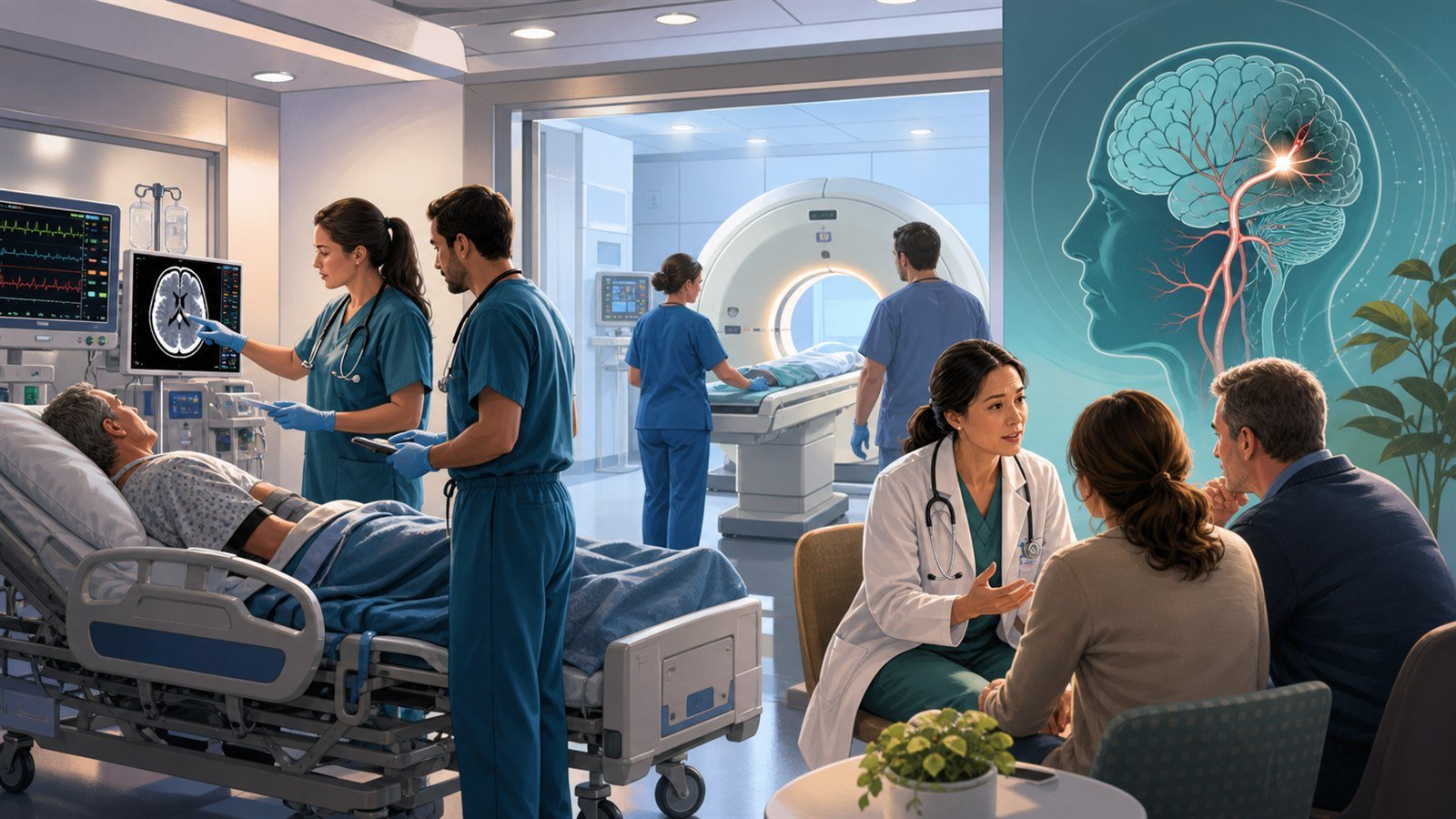
The first day is fast, but it has a pattern.
- →A stroke is always an emergency, even if symptoms improve. Call 911 and note the last time the person was definitely normal.
- →The first brain scan is usually a CT scan. Its first job is to look for bleeding, because clot and bleeding strokes are treated differently.
- →Medication lists matter. Blood thinners, antiplatelets, recent surgery, and the exact time symptoms started can change treatment decisions.
- →Swallow screens, blood pressure goals, repeated neuro checks, and therapy evaluations are not small details. They prevent complications and shape recovery.
- →The first 24 hours matter, but they do not tell the whole recovery story. Prognosis often becomes clearer over days, not minutes.
The first day after a stroke can feel like your world is spinning.
One moment, your loved one might be eating breakfast, heading to work, or watching TV. The next, they cannot speak clearly, one side of their face droops, an arm is weak, or they seem confused in a way you have never seen before. Suddenly, there is an ambulance, a rush to the emergency department, a CT scan, and a flurry of doctors and nurses asking questions. Decisions need to be made before you have even caught your breath.
Families often remember this day in flashes: the time symptoms started, waiting in the hallway, a nurse mentioning a swallow screen, or someone saying ICU. It is overwhelming.
This article is here to slow things down and help you understand what to expect. Stroke care is fast for a reason. Every second counts. But you deserve to know what is happening and why.
First: stroke is always an emergency, even if symptoms get better
If someone suddenly has face droop, arm weakness, slurred speech, vision changes, imbalance, confusion, numbness, or the worst headache of their life, call 911 right away. Do not wait to see if it goes away. Do not drive them yourself unless there is no other option.
Why? Because stroke treatment is very time-sensitive. In some cases, a clot-busting medication can be given within hours of symptom onset. For certain strokes, a clot-removal procedure called mechanical thrombectomy may be possible even later, depending on the scans.1
Also, sometimes symptoms improve but the danger is not gone. A transient ischemic attack, often called a TIA or mini-stroke, can be a warning sign of a bigger stroke. After the 911 call, clinicians may use the ABCD² score to estimate two-day stroke risk — it does not replace emergency evaluation.
The clock starts at the last time your loved one was seen normal, not when you discovered them. If they woke up with symptoms, the clock may start when they went to sleep. This detail can affect treatment options.
Write down the exact last-known-well time, the time symptoms were discovered, and the time 911 was called. Those three times help the stroke team reconstruct the story quickly.
The emergency team is trying to answer three big questions
When you arrive at the hospital, the team is moving fast. But the thinking is not random. Most of the early work is focused on three questions.
First: is this really a stroke, or something else? Low blood sugar, seizures, migraines, infections, medication effects, and other problems can sometimes look like stroke. That does not mean the symptoms are not serious. It means the team has to move quickly while still being accurate.
Second: is the stroke caused by a clot or by bleeding? An ischemic stroke is caused by blocked blood flow. A hemorrhagic stroke is caused by bleeding in or around the brain. The treatments are very different, so the first scan matters.
Third: is there a treatment that can restore blood flow or stop the injury from spreading? This is where timing, scans, medication history, exam findings, and blood pressure all come together.
The CT scan is usually the first big step
Most stroke patients get a CT scan of the head right away. Sometimes families are disappointed that the scan does not clearly “show the stroke.” That reaction is understandable, but the scan is doing an important job.
In the first minutes to hours of an ischemic stroke, a CT scan may look subtle or even normal. The main goal at first is often to look for bleeding. If there is bleeding, some clot-busting treatments are not safe. If there is no bleeding, the team can consider ischemic stroke treatments if the patient otherwise qualifies.
Many patients also get a CT angiogram, or CTA. This looks at the arteries in the head and neck to check for a large blocked artery. Some hospitals use additional imaging if the time of onset is unclear, the stroke is severe, or the team needs to know how much brain may still be saved.
Why everyone keeps asking about medications
One of the most important questions the team will ask is whether your loved one takes blood thinners. These include medications such as warfarin, apixaban, rivaroxaban, dabigatran, edoxaban, or injectable anticoagulants. The team will also ask about aspirin, clopidogrel, ticagrelor, and other antiplatelet medications.
They are not asking casually. These medicines can affect bleeding risk, which treatments are safe, and what to do next if the stroke is caused by bleeding.
If you can, bring a list or a photo of all medications, including doses and when they were last taken. This is incredibly helpful. A medication bottle with the label visible is better than guessing.
Why clot-busting decisions feel so fast
For some ischemic strokes, a medication like alteplase, often called tPA, or tenecteplase, often called TNK, can help dissolve the clot if given quickly. The team has to move fast because benefit decreases as time passes.1
Fast does not mean careless. The team is weighing the time, symptoms, scan results, blood pressure, bleeding risk, recent surgeries, blood thinners, and whether the symptoms are disabling.
Even if the stroke seems mild, it may still be serious. A person with a low stroke scale score might still be unable to speak, unable to use their dominant hand, or unable to see half the world. On the other hand, some symptoms may be too mild or too risky to treat with clot-busting medication. This is one of the hardest parts of stroke medicine: the decision is both protocol-driven and individualized.
Thrombectomy: physically removing a clot
If the scans show a large artery is blocked, a specialist may be able to remove the clot with a catheter, usually through the groin or wrist. This is called mechanical thrombectomy.
For the right patient, thrombectomy can be life-changing. But not every stroke qualifies. The team considers where the clot is, how much brain is already injured, how much brain may still be saved, how long it has been since the patient was last known well, and the person's baseline health.
You might hear terms like large vessel occlusion, core, penumbra, ASPECTS, or perfusion mismatch. In plain language, the team is asking: is there brain tissue we can still save, and can we do it safely?
What if the stroke is from bleeding?
If the CT shows bleeding, the priorities change. The team may focus on blood pressure control, reversing blood thinners, monitoring swelling, repeating scans, and deciding if a neurosurgeon needs to be involved.2
Some brain bleeds need ICU care, procedures, or surgery, but many are treated with close monitoring and medication. Removing blood from the brain is not always possible or safe. It depends on the location, size, pressure, cause of bleeding, and the patient's neurological exam.
This is also why repeated exams matter. A bleeding stroke can worsen early, and the team is watching closely for any sign of that.
Why the exam keeps getting repeated
You will notice the team asking your loved one to smile, raise their arms, name objects, look left and right, or follow commands again and again. It can feel repetitive, especially when everyone is tired.
But this is how the team spots early signs of worsening swelling, new bleeding, clot progression, seizure, low blood pressure effects, or improvement after treatment. The neurological exam is not just documentation. It is surveillance.
If you notice a new change, speak up. Families often know what is normal better than anyone in the room.
Swallow screening: small step, big impact
After a stroke, swallowing can be affected. This is called dysphagia. A patient may look awake and still silently aspirate, meaning food, water, or saliva can go toward the lungs instead of the stomach.
That is why a nurse will usually do a swallow screen before your loved one can eat, drink, or take pills by mouth. If they do not pass, a speech-language pathologist will evaluate further. This is not a punishment. It helps prevent pneumonia.
Please wait to offer water until the team says it is safe. That one cup of water can matter.
Blood pressure: sometimes higher is okay
This surprises many families. In some ischemic strokes, it can be safer to let blood pressure run higher for a period of time so blood can reach areas beyond a blockage. In other cases, especially after clot-busting medication or in bleeding strokes, tighter control is needed.
If you are worried about the numbers, ask the team what the blood pressure goal is for your loved one. Stroke blood pressure management is not one-size-fits-all.
Preventing complications: the quiet work
Beyond the dramatic moments, much of stroke care is quieter. The team is watching oxygen levels, fever, blood sugar, swallowing, hydration, bladder function, blood clots in the legs, skin issues, heart rhythm, and mental status.
They are also trying to figure out why the stroke happened and how to prevent another. That may mean heart rhythm monitoring, vessel imaging, echocardiogram, cholesterol testing, diabetes testing, and medication changes.3
This is where stroke care becomes detective work. The team is not only asking, “What happened?” They are asking, “Why did this happen, and how do we keep it from happening again?”
Recovery planning starts right away
Rehab does not wait until after discharge. Physical therapy, occupational therapy, and speech therapy often assess walking, talking, swallowing, memory, arm use, balance, and daily activities as soon as it is safe. How hard to push in that first day is its own decision, and a large trial changed the answer — see when to start rehab after a stroke.
This helps decide whether home, outpatient therapy, home therapy, skilled nursing, or inpatient rehab is needed. Even people who seem almost normal may have subtle issues that matter for driving, work, stairs, cooking, medication management, or living independently.
Families sometimes hear therapy recommendations and feel discouraged. Try to think of them as the next map, not a verdict. Rehab is how the team turns survival into function.
What families can do in the first 24 hours
You do not need to know every medical detail to help. The most useful things are practical.
- Write down when your loved one was last normal.
- Bring a medication list or photos of the medication bottles.
- Share medical history, allergies, surgeries, and baseline abilities.
- Tell the team about prior bleeding, recent falls, recent surgery, cancer, seizures, or previous strokes.
- Bring glasses, hearing aids, dentures, chargers, and contact information for close family or friends.
- Tell the team if your loved one speaks another language or has memory problems at baseline.
And ask questions. You are not bothering the team when you ask for clarity. Some good questions are:
- Is this an ischemic stroke or a hemorrhagic stroke?
- Is there a large blocked artery?
- Was clot-busting medicine considered? Why or why not?
- Was thrombectomy considered? Why or why not?
- What changes should we look for tonight?
- What is the blood pressure goal?
- Has swallowing been checked?
- What tests are being done to find the cause?
- What might recovery look like after discharge?
The hardest truth: the first day does not tell the whole story
Some people look very sick at first and recover dramatically. Others seem stable and then worsen from swelling, bleeding, a new stroke, infection, or other complications. Some deficits are obvious right away. Others show up only when your loved one tries to walk, talk, swallow, read, or return to daily life.
Everyone wants answers about recovery immediately. Doctors understand that. But the honest answer often takes time. Recovery depends on the stroke's size and location, age, prior health, treatment response, complications, rehab access, and support.
Sometimes the most honest answer is, “I need more time to know.” That is not avoidance. In stroke care, it is often the truth.
The goal of the first 24 hours
The aim is not just to admit the patient. It is to save as much brain as possible, prevent early problems, identify the stroke type and cause, protect swallowing and breathing, start rehab planning, and build the prevention plan.
Stroke care is fast because the brain is time-sensitive, but the best care is also thoughtful and compassionate. It is about helping your loved one survive, recover, and, ideally, not have a second stroke.
If you are reading this during or after a loved one's stroke, take a breath. Ask the team to explain things in plain language. Write things down. It is okay to ask the same question more than once.
The first day is overwhelming. But asking the right questions, getting the right scans, and starting the right treatments now can change the rest of the story.
Frequently asked questions
What is the most important thing families should know in the first 24 hours after stroke?
Know the last-known-well time, bring an accurate medication list, and tell the team about blood thinners, recent surgery, prior bleeding, seizures, and the person's baseline function. These details can change treatment decisions.
Why does the stroke team repeat the same exam so often?
Repeated neurological exams help detect worsening swelling, bleeding, clot progression, seizures, blood pressure-related changes, or improvement after treatment. Families should speak up if they notice a change.
Why can a patient not eat or drink right after a stroke?
Stroke can impair swallowing and cause silent aspiration. A swallow screen or speech-language pathology evaluation helps reduce the risk of pneumonia before food, water, or pills are given by mouth.
Does the first day predict stroke recovery?
Not completely. Some patients improve quickly, while others worsen or reveal deficits later. Prognosis depends on stroke size, location, age, prior health, treatment response, complications, rehabilitation, and support.
References
- Powers WJ, Rabinstein AA, Ackerson T, et al. Guidelines for the early management of patients with acute ischemic stroke: 2019 update to the 2018 guidelines. Stroke. 2019;50(12):e344-e418. PubMed
- Greenberg SM, Ziai WC, Cordonnier C, et al. 2022 guideline for the management of patients with spontaneous intracerebral hemorrhage. Stroke. 2022;53(7):e282-e361. PubMed
- Kleindorfer DO, Towfighi A, Chaturvedi S, et al. 2021 guideline for the prevention of stroke in patients with stroke and transient ischemic attack. Stroke. 2021;52(7):e364-e467. PubMed
- National Institute of Neurological Disorders and Stroke. Stroke signs and symptoms. NINDS
Related guides
Keep building the picture.
- What is a stroke? Start with the basics of ischemic and hemorrhagic stroke.
- ABCD2 score calculator Two-day stroke risk after a TIA — after the 911 call, not instead of it.
- Post-stroke dysphagia Why the swallow screen happens before any food, water, or pills.
- Post-stroke epilepsy The 7-day line between an early seizure and a diagnosis of epilepsy.
- IV thrombolysis eligibility Clinician-facing thrombolysis eligibility and dosing.
Article written by