What Is a Stroke? A Doctor's Guide — With the Story That Changes How You See It
Most people know the word "stroke." Very few know what it actually looks like when it's happening. A vascular neurologist explains — through a story from the ER.
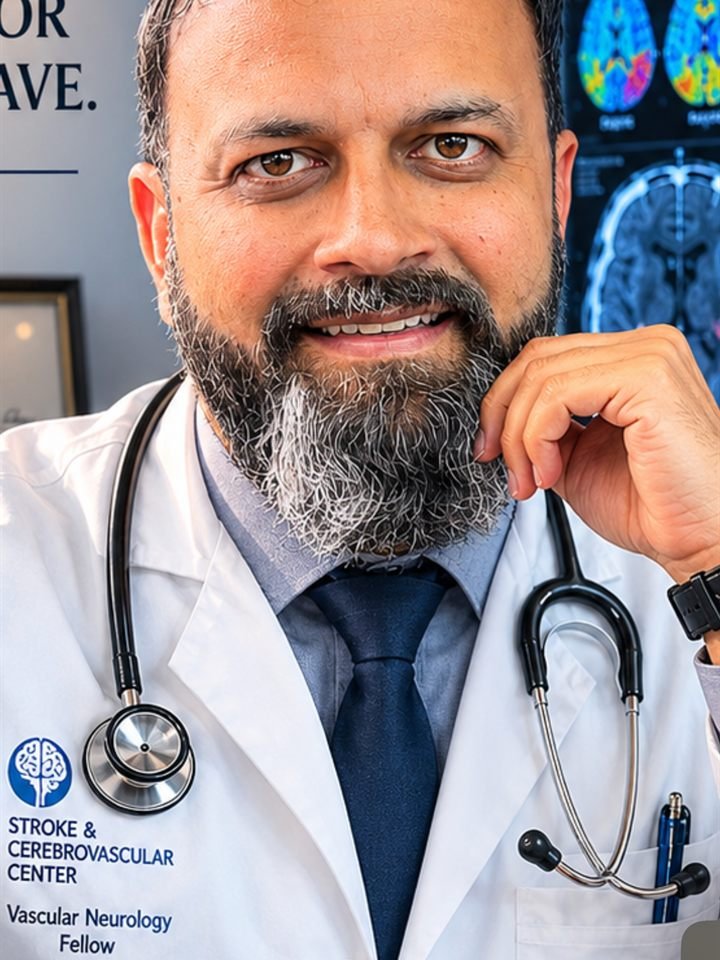
What every person needs to know — before it happens to someone they love.
- →A stroke kills approximately 1.9 million brain cells every minute it goes untreated. Every minute saved in treatment adds days of healthy life.1
- →87% of strokes are ischemic — caused by a clot — and can be treated with clot-busting medication or catheter-based clot removal.2
- →The most important thing you can do is recognize the signs using BE-FAST and call 911 immediately — do not wait, do not drive yourself.
- →More than 1 in 3 people who have a stroke do not call 911. The most common reason: they weren't sure it was serious enough.3
- →Clot-busting medication given within 4.5 hours can help prevent lasting disability in up to one-third of patients — but only if they arrive in time.
It was a Sunday afternoon when Margaret's husband noticed something was wrong.
She was sitting at the kitchen table, reaching for her coffee, when her right arm suddenly felt — in her words — like it belonged to someone else. She set the mug down awkwardly. He asked if she was okay. She opened her mouth to say yes, and what came out wasn't a word. It was a sound. Slurred, foreign, nothing like her voice.
He asked again. She smiled — or tried to. The left side of her face stayed still.
He thought: maybe she's tired. Maybe she didn't sleep well. Maybe it'll pass.
It didn't pass.
Forty-five minutes later, after searching her symptoms online and calling her daughter for advice, they finally called 911. By the time Margaret arrived in our emergency department, more than an hour had passed since that first moment at the kitchen table. In stroke care, an hour is not just time. An hour is the difference between walking out of a hospital and leaving in a wheelchair.
I tell you Margaret's story — a composite of patients I have cared for during my fellowship — not to frighten you, but because the most important thing I can teach anyone about stroke is this: the window closes fast, and hesitation is the enemy.
So what exactly is a stroke?
A stroke happens when blood flow to part of the brain is suddenly interrupted. Brain tissue is extraordinarily sensitive — unlike muscle or bone, neurons cannot survive more than a few minutes without oxygen and glucose. When the blood stops flowing, cells begin to die. Not over days or weeks. Within minutes.
There are two main types, and understanding the difference matters because the treatments are almost opposite.
Ischemic stroke accounts for about 87% of all strokes.2 This is what happened to Margaret. A clot — either formed locally in a brain artery or traveled from somewhere else, often the heart — blocks blood flow to a section of the brain. The tissue downstream begins to starve. The faster that clot is removed or dissolved, the more brain can be saved.
Hemorrhagic stroke accounts for the remaining 13%. Here, a blood vessel ruptures and bleeds into or around the brain. Rather than starvation, the problem is now pressure — blood pooling where it shouldn't be, compressing nearby tissue. The treatment approach is entirely different: sometimes surgery, sometimes blood pressure management, sometimes just close monitoring in an intensive care unit.
From the outside, both types can look identical — which is why we never guess. The first thing we do when a stroke patient arrives is get a CT scan of the brain. Always. It's the only way to tell them apart.
A stroke is not a heart attack of the brain — though people often say it that way. It's more like a power outage in a city. Cut the electricity to one neighborhood and only that neighborhood goes dark. Everything else stays on.
What the brain losing blood actually feels like
This is where stroke education often fails people. We teach signs and symptoms as a list. But stroke doesn't feel like a list. It feels sudden, weird, and — crucially — not always painful.
Most strokes don't hurt. That's part of what makes them so dangerous. A heart attack usually announces itself with crushing chest pain. Stroke can arrive quietly — a strange heaviness in an arm, a word that won't come out right, a visual field that suddenly looks wrong. Many patients describe it as their body doing something unexpected, rather than something that hurts.
And so people wait. They wonder if they slept wrong. They finish their coffee. They call their daughter. And the clock runs.
Research published in the journal Patient Preference and Adherence found that the most common emotional responses people have during a stroke are uncertainty and shame — not panic.4 Shame. People feel embarrassed to overreact. They don't want to be the person who called an ambulance over nothing. And so they hesitate, and hesitation costs them exactly what they were trying to protect — their dignity, their independence, their ability to speak.
How fast is the brain actually dying?
This is the number that stops people cold when I say it in clinic.
During a large-vessel ischemic stroke, the brain loses approximately 1.9 million neurons every single minute without treatment.1 That's also 14 billion synaptic connections and 12 kilometers of myelinated axons — per minute.
Put differently: every hour of untreated stroke ages the brain by 3.6 years.
The American Heart Association research goes further. For every 10-minute delay between arriving at the emergency room and starting treatment, patients with severe strokes lose an estimated eight weeks of healthy life.5 Eight weeks. For ten minutes of delay. Inside the hospital.
This is why the phrase "time is brain" isn't a slogan. It's a biological reality. And it's why, when Margaret arrived in our ER, the team was already moving before she reached the door.
1.9 million brain cells per minute. If you remember nothing else from this article, remember that number. Write it on a sticky note. Tell your parents. It is the most important reason to call 911 the moment you suspect a stroke — not after you've searched your symptoms, not after you've called someone for advice.
BE-FAST: the signs, and why FAST alone isn't enough
You've probably seen the FAST acronym — Face, Arms, Speech, Time. It's been on billboards and TV commercials for years. It works. But it misses something important.
FAST was designed to capture the most obvious signs of a large anterior-circulation stroke. But roughly 20–25% of strokes involve the back of the brain — the posterior circulation — and those strokes often don't cause face drooping or arm weakness at all. They cause dizziness, sudden vision changes, loss of balance, and coordination problems. And because those symptoms sound less "stroke-like," people ignore them even longer.6
This is why we now teach BE-FAST:
-
B
Balance — Sudden loss of balance or coordination. The person may stumble, veer to one side, or suddenly be unable to walk straight.
-
E
Eyes — Sudden vision change: blurred vision, double vision, or loss of vision in one or both eyes — without pain.
-
F
Face drooping — One side of the face droops or feels numb. Ask the person to smile — an uneven smile is a warning sign.
-
A
Arm weakness — One arm is weak or numb. Ask the person to raise both arms — if one drifts downward, that's a sign.
-
S
Speech difficulty — Slurred speech, inability to speak, or saying words that don't make sense. Ask the person to repeat a simple phrase.
-
T
Time to call 911 — The moment you notice even one of these signs, call 911. Do not wait. Do not drive to the hospital yourself.
A critical point about that last one: calling 911 is always faster than driving, even if the hospital is close. When an ambulance is dispatched for a suspected stroke, it does two things a car cannot — it stabilizes the patient en route, and it notifies the stroke team before arrival. That pre-notification alone reduces treatment delays by 20–35 minutes.7 Those minutes are not nothing. Those minutes are neurons.
What happens when you arrive at the hospital
When a stroke alert is called in the emergency department, the room shifts into a specific gear. The CT scanner is cleared. Blood is drawn. A neurologist is paged. Everyone moves fast — not because of protocol, but because everyone in that room understands the same calculation: every minute matters.
If the CT scan confirms an ischemic stroke and you're within the treatment window, the first option is tPA (alteplase or tenecteplase) — a clot-dissolving medication given through an IV. It can only be given within 4.5 hours of when symptoms started, and it works by breaking up the clot chemically. Roughly one-third of eligible patients who receive it avoid lasting disability.8
If the clot is large enough and in the right location, the next step is mechanical thrombectomy — a catheter-based procedure where an interventional team threads a device through the arteries and physically removes the clot. The results, when it works, are remarkable: patients who arrive aphasic and unable to move their arm sometimes wake up from the procedure speaking in full sentences.
Thanks to the DAWN and DEFUSE-3 trials, thrombectomy is now available to selected patients up to 24 hours from when they were last known to be well — a revolution in stroke care that happened just in the last decade.9 But "up to 24 hours" is not a license to wait. Earlier is always better. Every nine minutes of delay in reperfusion costs roughly one additional person per 100 treated their chance at a good outcome.10
People ask me: "What if I call 911 and it turns out to be nothing?" My answer is always the same — I have never once been annoyed at a false alarm. I have stood at the bedside of patients who waited, and watched what that waiting cost them. Call. Always call.
What happened to Margaret
Margaret received tPA in the emergency department. Her symptoms had started 68 minutes before she arrived — just inside the window where the medication could work.
Over the next 24 hours, her speech improved. Her arm came back. She went home four days later, walking, talking, and asking the nurses when she could have real coffee instead of the decaf they'd been giving her.
She was lucky. Not because the medicine worked — tPA works for about a third of the patients who receive it. She was lucky because her husband kept watching her. Because he didn't accept "I'm fine" as an answer when her face told him otherwise. Because when he finally called 911, there was still time.
Many people who have strokes aren't that lucky. Not because the medicine doesn't exist, or because the hospitals aren't ready. But because they waited — out of uncertainty, out of hope that it would pass, out of the very human instinct to not want to make a scene.
This article is for them. And for the person sitting next to them who might, one day, notice something wrong.
Don't wait. Call. The window closes faster than you think.
Frequently asked questions.
What is a stroke?
A stroke happens when blood flow to part of the brain is cut off — either by a clot blocking an artery (ischemic stroke, 87% of cases) or by a blood vessel rupturing (hemorrhagic stroke, 13%). Without blood, brain cells begin dying within minutes. Stroke is a medical emergency that requires immediate treatment.
What are the warning signs of a stroke?
Use BE-FAST: Balance (sudden loss of balance), Eyes (sudden vision change), Face drooping (one side), Arm weakness (one arm drifts down when raised), Speech difficulty (slurred or strange words), Time to call 911. Any single one of these symptoms is enough reason to call 911 immediately — even if you're not sure.
How quickly do brain cells die during a stroke?
During a large-vessel ischemic stroke, approximately 1.9 million brain cells die every minute without treatment. That is the equivalent of 3.6 years of normal brain aging per hour of untreated stroke. This is why every minute between symptom onset and treatment matters.
What is the difference between ischemic and hemorrhagic stroke?
Ischemic stroke (87% of strokes) is caused by a clot blocking a brain artery. Hemorrhagic stroke (13%) is caused by a blood vessel rupturing and bleeding into the brain. The symptoms can look nearly identical, but the treatments are very different — which is why a CT scan is always the first step in the emergency room.
Should I call 911 or drive to the hospital myself?
Always call 911. Ambulances do two things a car cannot: they stabilize you en route, and they notify the stroke team before you arrive — which reduces treatment delays by 20–35 minutes. Those minutes directly affect how much brain tissue can be saved. Even if the hospital is nearby, call 911.
What is the treatment for stroke?
For ischemic stroke, the main treatments are tPA (a clot-dissolving medication given within 4.5 hours of symptom onset) and mechanical thrombectomy (catheter-based clot removal, available for selected patients up to 24 hours). Earlier treatment consistently leads to better outcomes. For hemorrhagic stroke, treatment depends on the cause and location of the bleed and may involve surgery or intensive monitoring.
References.
- Saver JL. Time is brain — quantified. Stroke. 2006;37(1):263-266. PubMed
- Virani SS, Alonso A, Aparicio HJ, et al. Heart Disease and Stroke Statistics — 2024 Update. Circulation. 2024;149(8):e347-e913. AHA Journals
- Ramirez M, et al. Why more people don't call 911 when stroke symptoms hit. American Heart Association News. 2019. AHA
- Mandelzweig L, Goldbourt U, Boyko V, Tanne D. Perceptual, social, and behavioral factors associated with delays in seeking medical care in patients with symptoms of acute stroke. Patient Prefer Adherence. 2019;13:769-779. PMC
- Almekhlafi MA, et al. Every 10-minute ER delay may cost stroke patients 8 weeks of healthy life. Presented at: American Stroke Association International Stroke Conference; 2021. AHA Newsroom
- Aroor S, Singh R, Goldstein LB. BE-FAST (Balance, Eyes, Face, Arm, Speech, Time): Reducing the proportion of strokes missed using the FAST Mnemonic. Stroke. 2017;48(2):479-481. PubMed
- Prabhakaran S, et al. Patient and hospital-level factors associated with door-in-door-out times for inter-hospital transfer of patients with stroke. UChicago Medicine. 2023. UChicago Medicine
- Hacke W, Kaste M, Bluhmki E, et al. Thrombolysis with alteplase 3 to 4.5 hours after acute ischemic stroke. N Engl J Med. 2008;359(13):1317-1329. PubMed
- Nogueira RG, Jadhav AP, Haussen DC, et al; DAWN Trial Investigators. Thrombectomy 6 to 24 hours after stroke with a mismatch between deficit and infarct. N Engl J Med. 2018;378(1):11-21. PubMed
- Saver JL, Goyal M, van der Lugt A, et al; HERMES Collaborators. Time to treatment with endovascular thrombectomy and outcomes from ischemic stroke: a meta-analysis. JAMA. 2016;316(12):1279-1288. PubMed
Related guides
Keep building the picture.
- What is a TIA? The warning stroke that can look identical and then disappear.
- Golden hour in stroke The science behind time is brain and fast treatment.
- First 24 hours after stroke What families should expect after arriving at the hospital.
- IV thrombolysis eligibility Clinician-facing reperfusion eligibility and dosing.
Article written by