Stroke in Buffalo, NY: What My Patients Ask Me Every Day
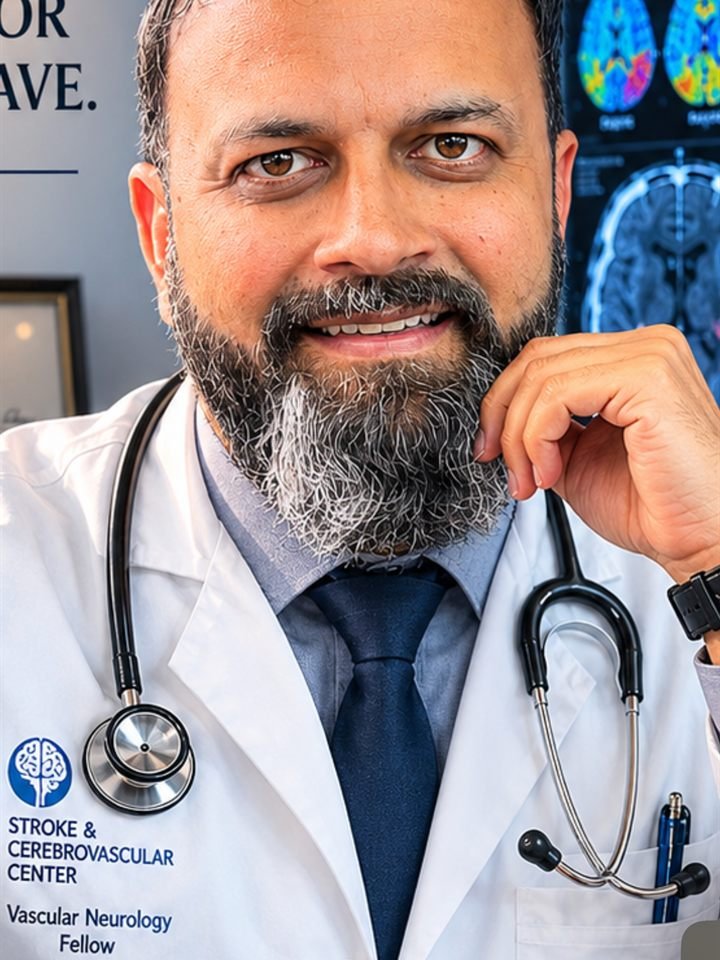
Dr. Zaka Ahmed, MD answers the questions he hears every day from stroke patients and families in Buffalo, NY — in plain, clear language.
What you need to know.
- →Stroke is a medical emergency. Call 911 immediately — do not drive yourself and do not wait to see if symptoms improve.
- →Remember BE FAST — Balance, Eyes, Face, Arm, Speech, Time. These are the warning signs you need to know by heart.
- →We have powerful treatments — but they only work if you arrive quickly. Every minute matters.
- →Buffalo and Western New York have a high burden of stroke risk factors — high blood pressure, diabetes, and smoking are very common here.
- →Most strokes are preventable. Knowing your numbers and taking your medicines consistently makes a real difference.
I am a vascular neurologist in Buffalo, New York. Every day I see patients and families in the hospital who are frightened, exhausted, and full of questions they did not know to ask before the stroke happened. This article is for them — and for you, before it happens.
These are the questions I hear most often at the bedside, answered in plain language, the same way I would talk to you in the room.
Why is stroke such a big problem in Buffalo?
I want to start here because it matters. Western New York has unusually high rates of the conditions that feed stroke. In my patients, I see high blood pressure that has gone untreated for years, diabetes that was never well controlled, heavy smoking histories, and limited access to regular preventive care. Our population is aging, and many communities in and around Buffalo carry a disproportionate share of cardiovascular disease.
The burden of ischemic stroke and blood vessel disease here is real and heavy. I see patients in their 80s who are not surprised to be in the stroke unit. But I also see patients in their 40s and 50s — sometimes younger — who had no idea they were at risk. That is what drives me to write this.
What exactly is a stroke?
A stroke happens when blood flow to part of the brain is suddenly cut off. Without blood, brain cells begin to die within minutes. There is no pause button and no restart — the damage happens in real time.
There are two main types:
- Ischemic stroke — a blood clot blocks a blood vessel inside the brain or neck. This is the most common type, accounting for about 87% of all strokes.
- Hemorrhagic stroke — a blood vessel bursts and bleeds into or around the brain. Less common but often more severe.
Both are emergencies. The brain does not store oxygen. That is why we say: "Time is brain." Every minute without blood flow, roughly 1.9 million brain cells die.1 This is not a figure meant to frighten you — it is a figure meant to move you.
How do I know if someone is having a stroke?
The signs of stroke are almost always sudden. That word matters. A headache that builds over days is rarely a stroke. A headache that hits like a thunderclap out of nowhere — that is different. The same applies to every symptom below.
I teach every patient and family the BE FAST acronym:
- BBalance — sudden loss of balance, trouble walking, unexplained dizziness
- EEyes — sudden blurred vision, double vision, or loss of vision in one or both eyes
- FFace — one side of the face droops when the person smiles
- AArm — one arm or leg is suddenly weak or numb; the arm drifts down when raised
- SSpeech — slurred words, wrong words coming out, or the person cannot speak or understand you
- TTime — time to call 911. Right now. Do not wait.
Please do not drive to the hospital yourself. Call 911. EMS can begin stroke care in the ambulance and alert the hospital before you arrive — this saves real time, and in stroke, time is everything.
"I would rather see you in the emergency department and find out it was not a stroke, than see you two hours too late when there is nothing I can do."
What can doctors actually do during a stroke?
This is one of the most important things I want families to understand. We have powerful tools — but they are time-dependent. The faster you come, the more options we have.
-
Clot-busting medicine (thrombolytics)
If you arrive within a few hours of symptoms starting, we may be able to give a medicine through an IV that dissolves the clot and restores blood flow to the brain. It does not work for everyone, and it has risks — but when it works, it works. I have seen patients arrive unable to speak or move their arm, and walk out of the hospital days later. -
Thrombectomy (clot removal procedure)
For large clots in major blood vessels, our endovascular team can guide a thin catheter through the arteries, reach the clot, and remove it directly. This procedure has transformed stroke care over the last decade. In the right patient, it can be performed hours after the stroke began — but outcomes are still better the earlier we act. -
Brain protection and monitoring
We carefully control blood pressure, blood sugar, oxygen, and body temperature. We watch for brain swelling, bleeding complications, and fever. All of this gives the brain the best possible environment to recover.
These treatments only exist if you get here in time. When families tell me they waited because they thought the symptoms might go away on their own, that is the hardest conversation I have. Please do not wait. Call 911 the moment you suspect a stroke.
How can I lower my stroke risk?
This is where most strokes are actually prevented — not in the hospital, but in the months and years before. Here is what I tell my own patients in Buffalo:
-
Know your blood pressure — and treat it.
High blood pressure is the single most important modifiable stroke risk factor. The goal for most people with risk factors is below 130/80. Check it at home. Bring the numbers to every doctor's visit. Take your medicine every day, not just when you feel bad. Blood pressure does not cause symptoms until it causes a crisis. -
Control diabetes and cholesterol.
Elevated blood sugar damages blood vessel walls over time. Statins — cholesterol medicines — protect your brain, not just your heart. If your doctor recommended a statin, take it. -
Do not smoke.
Smoking accelerates damage to blood vessels throughout the body, including the brain. If you smoke, quitting is the highest-yield stroke prevention step you can take. Ask your doctor for help — there are medicines and programs that work. -
Move your body most days.
You do not need a gym. Brisk walking for 20–30 minutes most days lowers blood pressure, improves blood sugar, and reduces stress. Start where you are. -
Take blood thinners if they are prescribed.
If you have atrial fibrillation (an irregular heartbeat), blood thinners can dramatically reduce your stroke risk. Missing doses puts you back at full risk very quickly. Set a daily alarm if that helps.
What happens after a stroke?
Recovery is not a straight line, and it does not end when you leave the hospital. The brain has a remarkable ability to rewire itself — a property called neuroplasticity — and rehabilitation is the work of encouraging that rewiring. Physical therapy, occupational therapy, and speech therapy all play a role.
It is also normal to feel depressed, exhausted, anxious, or emotionally raw after a stroke. These are part of the condition. Post-stroke depression is very common and very treatable. Please tell your doctor if you are struggling — you are not expected to simply push through.
Follow-up appointments after a stroke matter. We adjust medicines, monitor for another event, and build a long-term prevention plan specific to you. Do not skip them.
What I want you to remember
I want you to leave this article with three things:
- Stroke is common in our community, but many strokes are preventable.
- If you see the signs of stroke, call 911 immediately — every minute matters.
- You are not alone. Your doctors, nurses, therapists, and community are here.
This is how I talk to my patients in Buffalo. My goal with TheVascularBrain.com is to bring the same honest, patient, and clear conversation online — one article at a time. If you have questions, I am here.
— Zaka Ahmed, MD
Vascular Neurologist, Buffalo, New York
Frequently asked questions.
What are the warning signs of a stroke?
The BE FAST acronym covers the main warning signs — sudden Balance loss, Eye changes, Face drooping, Arm weakness, Speech problems, and Time to call 911. Any of these appearing suddenly is a reason to call 911 immediately. Do not wait to see if symptoms improve on their own.
What is the difference between a stroke and a TIA?
A TIA (transient ischemic attack) — sometimes called a mini-stroke — produces the same symptoms as a stroke but they resolve on their own, usually within minutes to an hour. A TIA is a serious warning sign that a full stroke may be coming soon and requires immediate emergency evaluation. Do not ignore it because the symptoms went away.
Should I drive to the hospital or call 911?
Call 911. EMS can begin stroke evaluation in the ambulance, alert the hospital before you arrive, and bring you directly to imaging. Driving yourself can delay treatment by 30–60 minutes and puts you and others at risk if your condition changes behind the wheel.
How is an ischemic stroke treated?
The two main treatments are clot-busting medicine (thrombolytics such as tPA or tenecteplase) given through the vein, and mechanical thrombectomy, where a catheter is guided through the arteries to remove the clot directly. Both treatments are time-dependent — the sooner you arrive, the more we can offer.
How can I lower my stroke risk?
The most important steps are controlling blood pressure (goal below 130/80 for most people with risk factors), managing diabetes and cholesterol, stopping smoking, staying physically active, and taking blood thinners consistently if prescribed for conditions like atrial fibrillation. Ask your doctor what your personal stroke risk is and what your prevention plan should be.
Why is stroke so common in Buffalo, NY?
Western New York has high rates of the major stroke risk factors — high blood pressure, diabetes, smoking, and obesity — along with an aging population and limited access to preventive care in some communities. These factors together create a high burden of ischemic vascular disease in the region.
References.
- Saver JL. Time is brain—quantified. Stroke. 2006;37(1):263-266. PubMed
- Feigin VL, Stark BA, Johnson CO, et al. Global, regional, and national burden of stroke and its risk factors, 1990–2019: a systematic analysis for the Global Burden of Disease Study 2019. Lancet Neurol. 2021;20(10):795-820. PubMed
- Powers WJ, Rabinstein AA, Ackerson T, et al. Guidelines for the early management of patients with acute ischemic stroke: 2019 update. Stroke. 2019;50(12):e344-e418. PubMed
- Benjamin EJ, Muntner P, Alonso A, et al. Heart disease and stroke statistics — 2019 update: a report from the American Heart Association. Circulation. 2019;139(10):e56-e528. PubMed
Related guides
Keep building the picture.
- What is a stroke? A deeper answer to the most common question patients ask.
- What is a TIA? Why a warning stroke should not be ignored.
- Patient guides Plain-language emergency and recovery guidance for families.
- Stroke hub The main site guide to symptoms, treatment, recovery, and prevention.
Article written by